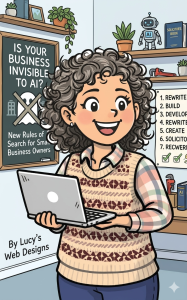
 When did you last ask ChatGPT or Google’s AI Overview to recommend a local service? Maybe a web designer near you, a plumber, a solicitor, or a care provider? Chances are you’ve done it recently and so have your potential customers.
The problem is, if your business isn’t set up in the right way, AI simply won’t mention you. Not because you’ve done anything wrong but because AI has different rules to traditional Google search and most small businesses don’t know what they are yet.
I came across a video this week by Kyle Balmer (AI with Kyle) that neatly breaks down what Ahrefs one of the most respected SEO research companies in the world found when they analysed how AI decides which businesses to recommend. The findings are eye-opening, and the practical checklist at the end of Kyle’s video is something every business owner should pin to their wall.
Let me walk you through it.
1 The shift from SEO to AEO
For the past decade, getting found online has meant ranking on Google’s search results pages the classic “blue links”. You optimised your website for keywords, built backlinks, and hoped to appear on page one.
That’s still important. But something significant has changed.
When someone now types a question into ChatGPT, Perplexity, Google’s AI Overview, or Microsoft Copilot, they don’t get ten links to choose from. They get one answer. A direct recommendation. And if your business isn’t in that answer, you effectively don’t exist for that search.
This is called Answer Engine Optimisation (AEO) — and it’s the next evolution of how businesses need to think about their online presence.
Ahrefs studied millions of AI citations across platforms and found some fascinating patterns. Here are the key ones.
What the Ahrefs research actually found
1. Websites with more organic search traffic get mentioned more in AI answers
This is good news if you already invest in SEO — it still matters. Ahrefs found that sites with stronger traditional search performance tend to get more citations in AI Overviews and Perplexity. So your existing SEO work isn’t wasted; it provides a foundation.
However and this is important there’s only a weak correlation between high organic traffic and being cited by ChatGPT specifically. In other words, ChatGPT plays by slightly different rules to Google’s AI. Just because Google ranks you well doesn’t mean ChatGPT will recommend you.
2. YouTube mentions and branded web mentions are the top factors for AI visibility
This is the finding that surprised people most. Ahrefs found that YouTube mentions and branded web mentions are the strongest signals for appearing in ChatGPT, Google’s AI Mode, and AI Overviews.
Think about what that means. It’s not just about your website anymore. It’s about how often your business name is mentioned across the internet in articles, directories, reviews, forums, podcasts, and yes, YouTube videos.
Brands in the top 25% for web mentions get 10 times more AI visibility than brands with fewer mentions. If nobody’s talking about you online, AI has no reason to know you exist.
3. Only 13.7% of citations overlap between Google’s AI Overview and Google’s AI Mode
Google has two AI features, AI Overview (the box at the top of search results) and AI Mode (a more conversational search experience) and they pull from largely different sources. This means you can’t assume that appearing in one guarantees you appear in the other.
4. 44% of all AI citations come from the first 30% of a page
AI reads your content in a particular way. Nearly half of everything it cites comes from the opening section of a page the intro, the first few paragraphs. If you bury the important stuff halfway down a long article, AI may never pick it up.
This means your homepage, your service pages, and your blog posts all need to lead with clarity. Who you are, what you do, and who you help should be front and centre not tucked away after a lengthy preamble.
5. ChatGPT only cites 50% of the pages it retrieves — and 88% of those come from Google search results
Here’s a revealing one. Even when ChatGPT retrieves your page, it only actually cites it half the time. And the vast majority of what it retrieves comes directly from Google search results. So if Google can’t find you, ChatGPT almost certainly won’t either.
This reinforces that traditional SEO and AI visibility are linked but they’re not the same thing.
Why this matters for your business right now
You might be thinking: “My customers aren’t using ChatGPT to find local businesses.”
Maybe not yet in large numbers. But the direction of travel is clear. AI search is growing rapidly, Google itself has integrated AI into most searches, and younger audiences in particular are using AI tools as their first port of call for recommendations.
More importantly, these findings point to something bigger than just AI search. They highlight businesses that have built a web of proof around themselves online and those that haven’t.
That phrase “a web of proof” is from Kyle’s video, and I think it’s the best way to describe what you’re building when you do this properly. It’s not about gaming an algorithm. It’s about making it undeniably obvious, across the whole internet, that your business is real, credible, trustworthy, and helpful.
The “What To Do This Month” checklist
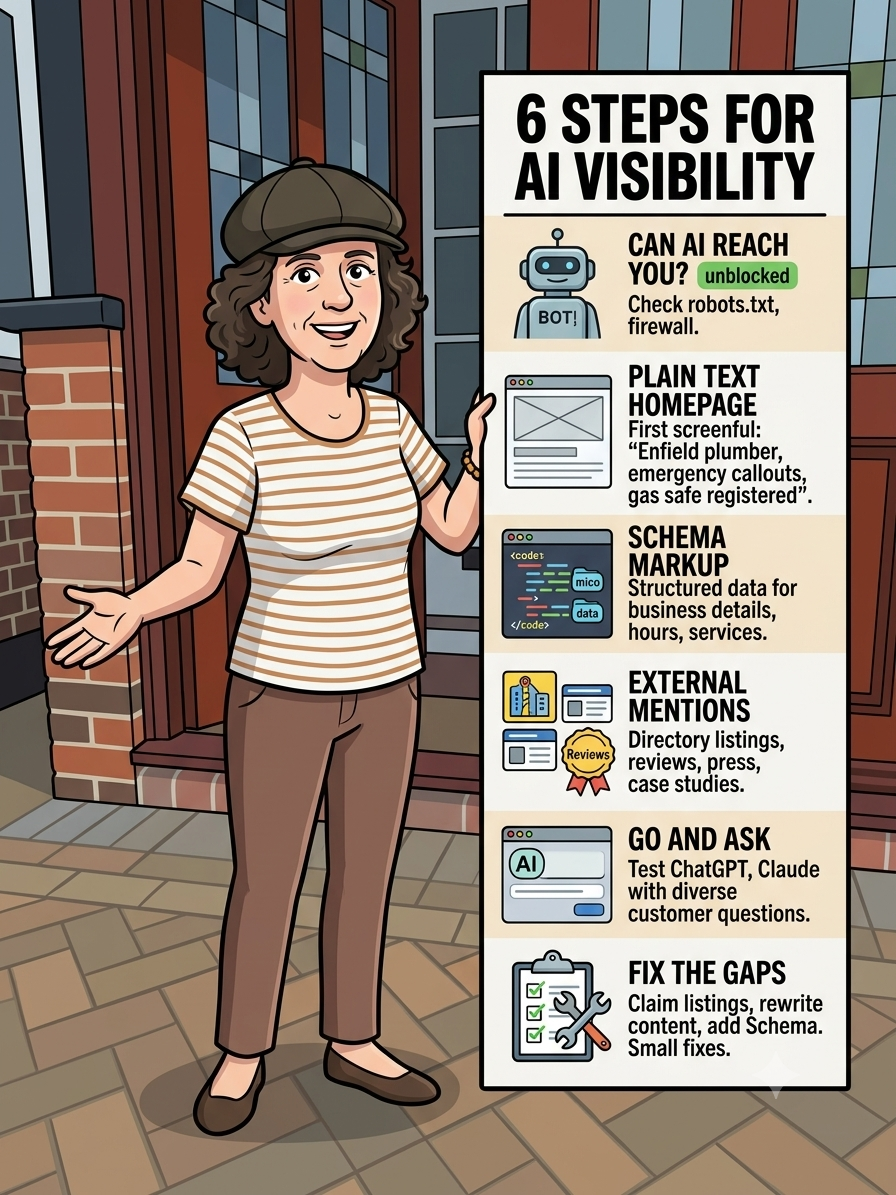
This is the practical checklist Kyle shared, drawn from the Ahrefs research. Think of it as your AEO starter kit eight things you can work through to start building that web of proof.
1. Rewrite your homepage so it clearly says who you help
Your homepage has one job: tell the right person, in the clearest possible terms, that you’re exactly what they’re looking for. Not vague brand statements, not “welcome to our website” — but a specific, direct explanation of what you do and who you do it for.
For example: Instead of “We create beautiful websites”, try “We design websites for small businesses in Hertfordshire who want to be found online and win more customers.”
AI reads your homepage first. Make it count.
2. Build one strong service page per core offer
Every service you offer should have its own dedicated page. Not a single “Services” page with everything crammed in, but individual pages for each offering — written in enough depth that AI can understand what you do and when you’d be the right recommendation.
These pages should answer the obvious questions: What does this service include? Who is it for? What problem does it solve? How much does it cost (or how do you find out)? What happens next?
3. Publish one useful guide that answers a real buyer question
Think about the questions your customers ask before they even reach out to you. Things like: “How much does a website cost?” or “Do I need a website or can I just use social media?” or “What’s the difference between a website builder and a professional web designer?”
Write a proper, helpful, honest answer to one of those questions. Not a sales piece — a genuine guide. This is the kind of content AI loves to cite, because it’s answering the same question the user is asking.
4. Add two case studies with specifics
“We built a beautiful website for a local restaurant” is forgettable. “We redesigned the website for …. the new site increased their online reservations by 40% in three months” is something AI can work with.
Case studies with real details client type, problem, solution, outcome are enormously powerful for both AI visibility and human trust. You only need two to start. Pick your best two pieces of work and write them up properly.
5. Ask happy customers for reviews
Reviews are one of the clearest signals that your business is real and trusted. Ask your happy clients to leave reviews on Google, Trustpilot, or industry directories — whichever is most relevant for your sector.
Don’t just hope people will do it; ask them directly, ideally straight after a successful project when they’re most enthusiastic. A simple message saying “We’d really appreciate a quick Google review if you’re happy with what we delivered” works far better than a generic automated email.
6. Turn one proof point into a short video
Remember the Ahrefs finding: YouTube mentions are one of the top factors for AI visibility. You don’t need a polished production. A short video — even filmed on your phone — where you walk through a project, explain your process, answer a common question, or share a client result, creates a mention of your business in the most AI-visible place on the internet.
Post it to YouTube with a clear title that includes what you do and where. It doesn’t need thousands of views to help.
7. Pitch one partner, directory, or industry list
Every time your business name appears on another credible website — a local business directory, an industry association, a partner’s website, a “best of” list — that’s another point in your web of proof.
Make a list of directories, associations, and relevant websites where your business should be listed but isn’t yet. Aim to get onto one new one this month. Over time, these accumulate into a pattern of mentions that AI treats as a trust signal.
8. Update old content that still matters
If you have existing pages or blog posts that get some traffic but haven’t been updated in a year or more, refresh them. Update the information, improve the opening paragraph (remember 44% of AI citations come from the first 30% of a page), and make sure they clearly answer the question they’re targeting.
Old content that’s been refreshed often outperforms new content, because it already has some authority it just needs to be brought up to date.
Where to start
The checklist above might feel like a lot if you’re looking at it all at once. The key is to pick one and do it this month. Just one.
If you’re not sure which to start with, my recommendation is usually number one the homepage. It’s the page AI looks at first, it’s the page your potential customers see first, and it’s the most common place I see businesses underselling themselves with vague, woolly language that doesn’t actually tell anyone what they do.
Get your homepage right, and everything else builds on a stronger foundation.
Need help putting this into practice?
At Lucy’s Web Designs, this is exactly the kind of thing we help small businesses with not just building websites, but making sure they’re set up to be found, whether that’s by Google, ChatGPT, or the next AI platform that comes along.
If you’d like a free review of your current website and a conversation about where the gaps are, get in touch. We’re always happy to have an honest chat.
In the last 6 months at @Ahrefs, we analyzed over 1 billion data points across 14 studies. Here's what we learned about AI search optimization:
1) "Best X" blog listicles are the single most prominent content format cited by AI chatbots. They make up 43.8% of all page types…
— Tim Soulo 🇺🇦 (@timsoulo) June 2, 2026