 Funnily enough, just as I had started looking into how businesses get found through ChatGPT, Claude and all the other new AI search tools, the phone rang….
A lady wanted to talk to me about a website and, as is my way, I asked how she had found me. I assumed she would say Google, a recommendation, or perhaps that she had spotted my name at the bottom of one of the many websites I have built over the years.
No, she had found me through ChatGPT!
Well, you can imagine how pleased I was, especially as I had spent the day learning about this very subject. It was one of those lovely little moments when something you have been reading about suddenly becomes real. People really are asking ChatGPT to recommend web designers, accountants, therapists, shops and all sorts of other businesses—and ChatGPT is giving them names.
So, of course, this got me thinking….
How had it found me? Why had it chosen my business? And, most importantly, what can other small businesses do to give themselves a better chance of appearing when somebody asks an AI assistant for a recommendation?
There is, needless to say, no magic button. Nobody can promise that ChatGPT will recommend your business every time, in much the same way that nobody can honestly promise to put you at number one on Google. There are far too many things involved.
But you can make your business much easier for ChatGPT and the other AI tools to understand—and that is a very good place to start….
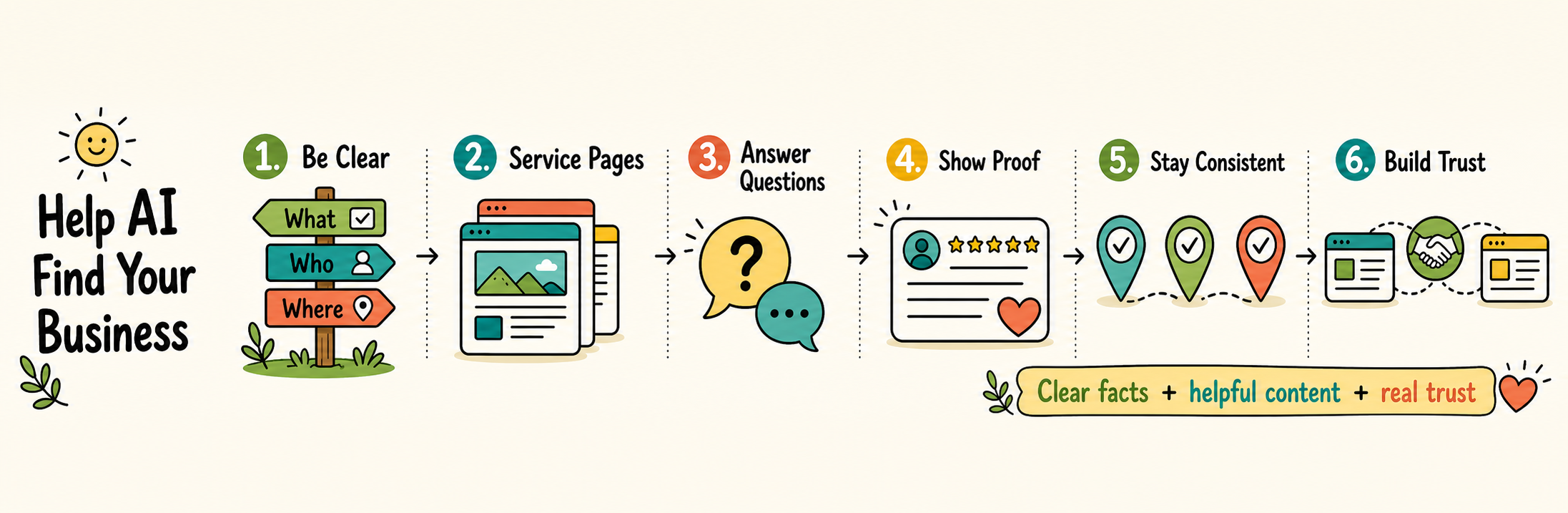
First of all, explain what you actually do
This sounds rather obvious, doesn’t it? Yet you would be surprised by how many websites make you hunt around before you can work out what the business actually does.
You arrive on a homepage and are greeted with something like “Helping you achieve your dreams” or “Innovative solutions for a changing world.”
Lovely—but what do you do?
Are you an accountant, a hypnotherapist, a web designer, a dog groomer or someone who sells particularly innovative garden sheds?
It is important to tell people clearly who you are, what you offer, who you help and where you work. This is also helpful to Google, ChatGPT and the other AI search tools, as they are trying to piece together exactly the same information.
For example, I might describe my own business like this:
“Lucy’s Web Designs creates bespoke WordPress websites for small businesses in Enfield, North London and across the UK. I also provide hosting, SEO, website training and AI Search Visibility audits.”
It isn’t flowery, but it is clear. ChatGPT does not have to rummage through twenty pages trying to work out what I do, and neither does a potential client.
Give each service a proper page
I sometimes come across websites where every service has been squeezed onto one page, usually with a small paragraph and a “find out more” button that doesn’t actually lead anywhere.
If something is an important part of your business, give it its own page.
For me, that might mean separate pages for:
- Bespoke WordPress web design
- Online shops
- Hosting and website care plans
- Search engine optimisation
- AI Search Visibility
- WordPress training
- AI and Microsoft Copilot training
This gives me room to explain each service properly—who it is for, what is included, how it works and what somebody can expect if they decide to work with me.
It also means that if somebody asks ChatGPT, “Can you recommend somebody who offers WordPress training in Enfield?” there is a clear page on my website answering that particular question.
If all I have written is “I do training too” tucked away at the bottom of another page, it is far more difficult for anybody—or anything—to find.
Think about the questions people ask you
This is probably one of the easiest things you can do.
What do people ask when they telephone or email you?
I am asked things such as:
- How much does a website cost?
- How long will it take?
- Will I own my website?
- Will I be able to update it myself?
- Is WordPress better than Wix?
- Can you improve the website I already have?
- Do you provide hosting?
- Can you help my website appear in ChatGPT?
These are not questions dreamt up by a marketing department; they are the things real people want to know.
Write them down and answer them on your website in the same clear language you would use when speaking to a client. Give the straightforward answer first and then add more detail if it is needed.
AI assistants are built around questions and answers, so a website containing clear, useful answers gives them far more to work with.
You don’t need to sound clever. In fact, I think trying too hard to sound clever often makes a website far less helpful. Just imagine that the person is sitting opposite you and explain it to them.
Show people that you really know what you are doing
Anyone can write “We offer an excellent, professional service” on a website. It is one of those phrases that has appeared so often that it doesn’t really tell us anything.
The interesting bit is the proof.
Show examples of your work. Add proper case studies. Include genuine reviews. Explain what you did, why you did it and what difference it made.
If you have been doing something for years, say so. If you have built hundreds of websites, mention it. If a client came to you with a terrible old site and ended up with something beautiful, fast and easy to use, tell that story.
I have worked in web design since 2010 and have built hundreds of websites, but simply writing that sentence is only the beginning. My portfolio, client reviews and case studies help to support it.
This all builds trust with potential clients, but it also gives search engines and AI tools consistent evidence that you are who you say you are.
And quite honestly, the stories behind the work are usually much more interesting than a page filled with sales language anyway….
Keep your details consistent
Your business name, telephone number, website address, location and description should be consistent wherever they appear online.
That includes places such as:
- Your Google Business Profile
- Bing Places
- Facebook and Instagram
- Local business directories
- Professional membership sites
- Client websites
- Any other profiles you have created over the years and then completely forgotten about!
I have certainly found old profiles containing outdated wording, an old logo or a service I no longer offer. It happens easily. You set something up, life moves on and ten years later there it is, floating around the internet like a little time capsule.
It is worth having a look and tidying them up.
Small differences are not necessarily a disaster, but completely conflicting information can make it harder for search tools to understand whether two listings refer to the same business.
Choose one proper version of your business name and a simple description of what you do, then use them consistently.
Make sure the website itself is in good health
You can have the most wonderful content in the world, but it won’t help much if your website is difficult to use or search engines cannot understand it.
Some of the technical things worth checking include:
- Does the website work properly on a mobile phone?
- Do the pages load reasonably quickly?
- Does each page have one clear main heading?
- Does every important page have its own title and description?
- Can search engines find and index the pages?
- Are related pages linked together?
- Do images have sensible descriptions?
- Is the website secure?
- Is any important information accidentally duplicated?
- Does the structured data work properly?
Structured data—also known as schema markup—is information hidden behind the page that helps search systems understand what they are looking at.
It can identify things such as your business, services, reviews, articles and frequently asked questions.
It isn’t very exciting to look at and it certainly isn’t a magic wand, but it can help machines make sense of your website. Think of it as adding helpful little labels behind the scenes.
Get mentioned in other places
Naturally, your own website is going to say that your business is wonderful. It would be a little odd if it didn’t.
It becomes more convincing when other people say it too.
Links and mentions from relevant, trusted websites can help confirm that your business is established and genuine.
You might be mentioned by:
- Clients whose websites you have created
- Local business organisations
- Professional associations
- Suppliers or business partners
- Charities and community groups
- Industry publications
- Podcasts or local news sites
This doesn’t mean buying hundreds of peculiar links from websites nobody has ever heard of. I receive emails offering that sort of thing all the time and, needless to say, they go straight in the bin.
A genuine mention from a real client, local organisation or respected business is far more worthwhile.
Write about the things you genuinely know
A blog can still be incredibly useful, particularly when you use it to answer the questions you regularly hear from clients.
You don’t need to publish something every day—or even every week. I would much rather read one thoughtful, useful article written by a real person than twenty bland articles created simply to fill a website.
Possible subjects might include:
- How much should a small-business website cost?
- What should I ask a web designer before hiring them?
- Can ChatGPT find my website?
- What is AI Search Visibility?
- What is the difference between SEO and AI search?
- Will I be able to update my own website?
- WordPress or Wix—which should I choose?
- How often should a business website be updated?
Use your own knowledge, opinions and experiences. Include the funny things that happen, the mistakes you have seen and the lessons you have learnt.
That is the material nobody else can copy because it belongs to you.
I think this will become even more important as the internet fills with perfectly tidy—but rather soulless—articles. Real experiences, genuine expertise and a recognisable voice stand out.
Is this all replacing Google and traditional SEO?
No, I don’t think we should all abandon Google and start talking exclusively to robots just yet!
People still search on Google, and many AI tools also use information they find across websites and search results.
The best approach is to make your website useful however somebody discovers it—through Google, ChatGPT, Claude, Perplexity, a recommendation, social media or because they spotted your name at the bottom of a website you created.
Good SEO and good AI visibility have a lot in common:
- Clear, well-organised pages
- Helpful original information
- A technically sound website
- Consistent business details
- Reviews and case studies
- Relevant links and mentions
- Properly answered questions
- Evidence that you really know your subject
It is less about trying to trick a machine and more about making your business easy to understand and trust.
That seems a much more sensible way of looking at it.
So, can ChatGPT find your business?
Perhaps—but the more useful question is whether ChatGPT can clearly understand what your business does and find enough reliable information to feel confident mentioning it.
That is what I am now looking at with my AI Search Visibility audits.
I check whether a website clearly explains its services, whether its important pages can be found, whether the business information is consistent and whether the content answers the sort of questions potential clients are asking.
I also look at the technical bits behind the scenes, but I promise not to hand you a baffling report filled with unexplained jargon and then disappear!
You will receive practical suggestions that make sense and that can actually be acted upon.
The fact that somebody has already found me through ChatGPT was a wonderful surprise and, I must admit, rather exciting. It made all of this feel much less like something that might happen in the future and much more like something that is happening right now….
If you are curious to know whether ChatGPT and the other AI search tools can understand your website, do get in touch.
You never know who might be asking them for a recommendation!