An Evening at Little Park: Exploring the Tudor Room on Gentleman’s Row
Local & Family History
Last night we were among 31 lucky visitors invited to see one of Enfield’s best kept secrets: the Tudor Room at Little Park, number 5 Gentleman’s Row. It is a private house, so a visit like this does not come along often, and it did not disappoint.
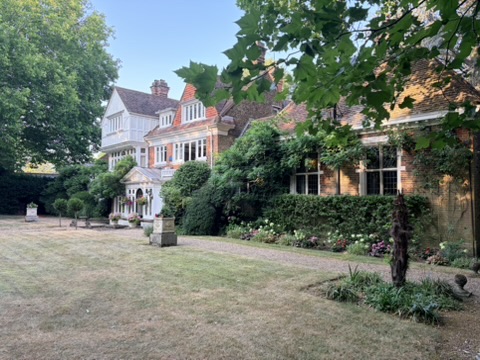
Getting there
With so much interest in the visit, our hosts split the 31 guests into two groups so everyone had a proper chance to look around and take photographs, one group from 7.00pm to 7.30pm and the second from 7.30pm to 8.00pm. We were asked to arrive by 6.45pm, leave our bags at the door, and keep the noise down, since this is still very much a family home. No videos, but photographs were welcome, which is how we came away with such a lovely set of pictures.
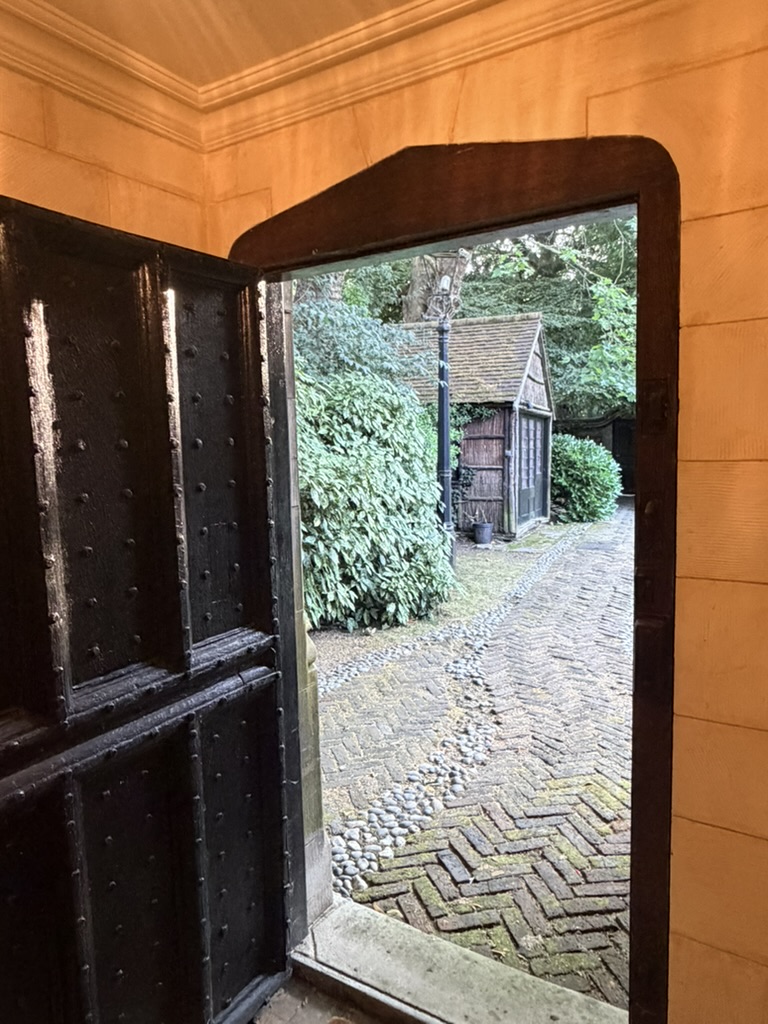
The room itself
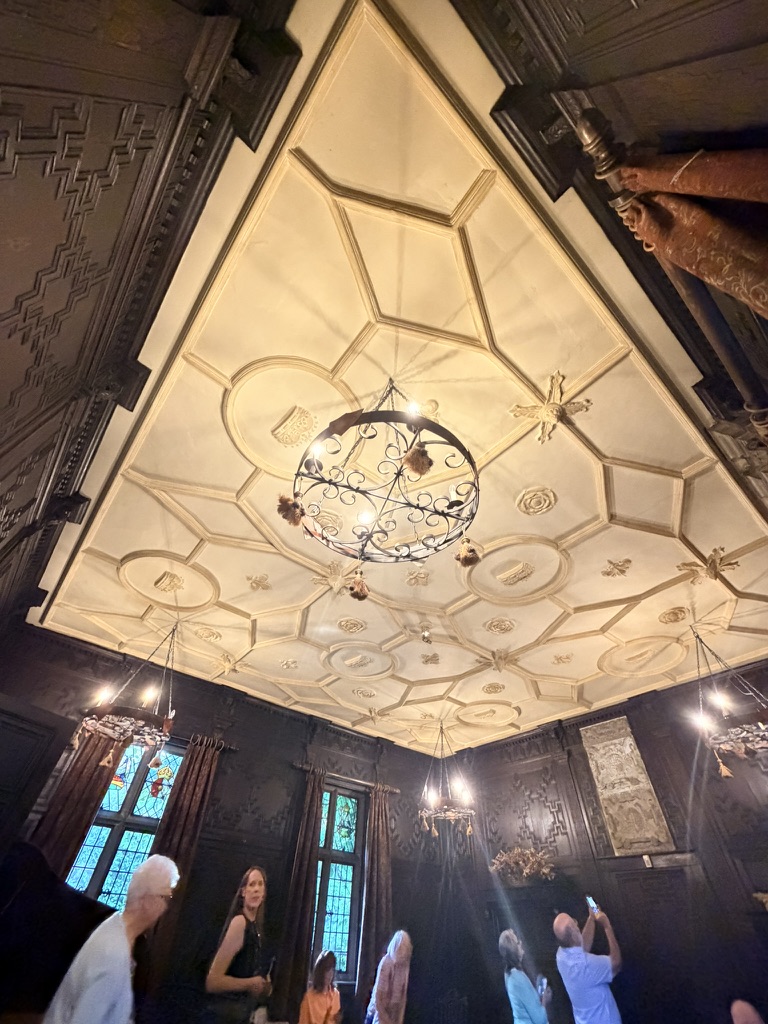
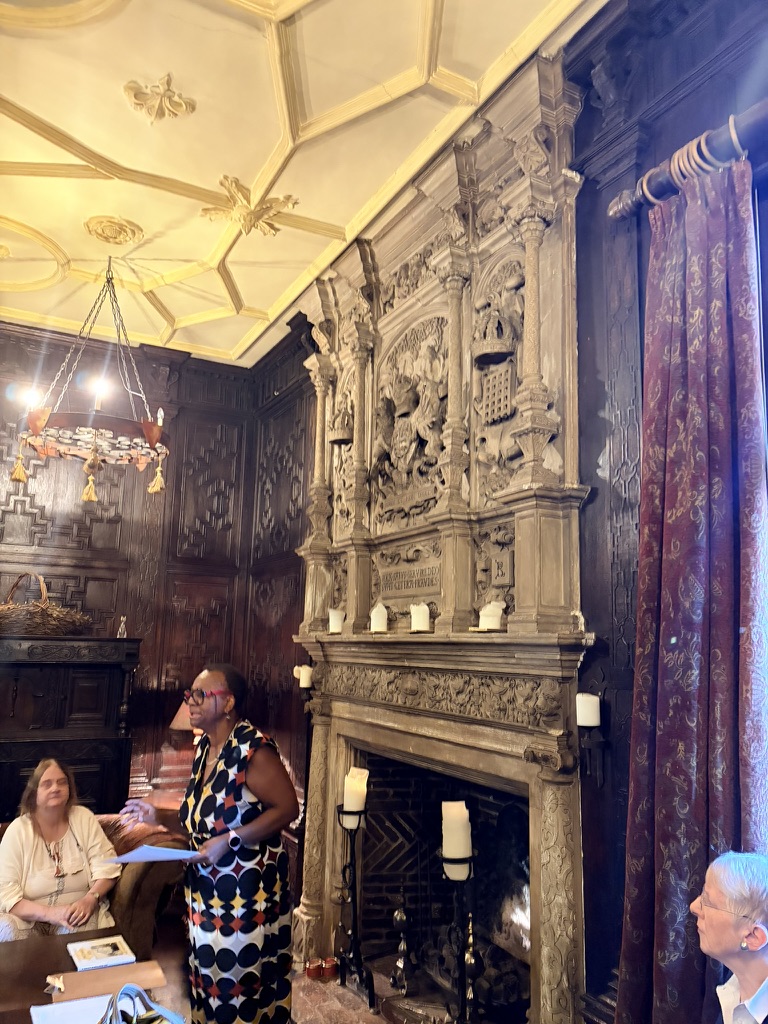
The Tudor Room was not always here. It was purpose built in 1928 by the Legatt brothers as an extension to their own home, Little Park, and it exists because of an act of rescue. When the old Enfield Manor House in Enfield Town, sometimes mistakenly called Enfield Palace, was sold to Pearsons for their new department store, the Legatt brothers salvaged the finest of its Tudor panelling, plasterwork and stone fireplaces before the bulldozers moved in, and had this room built especially to house them. Without their foresight, these pieces would almost certainly have been lost.
Our guide for the evening, Avril, walked us through the room’s history and its remarkable decorative detail.
Two great fireplaces
There are two carved overmantels in the room, and our guide pointed out the difference in their columns, one flanked by plain Ionic columns and the other by more ornate Corinthian columns.
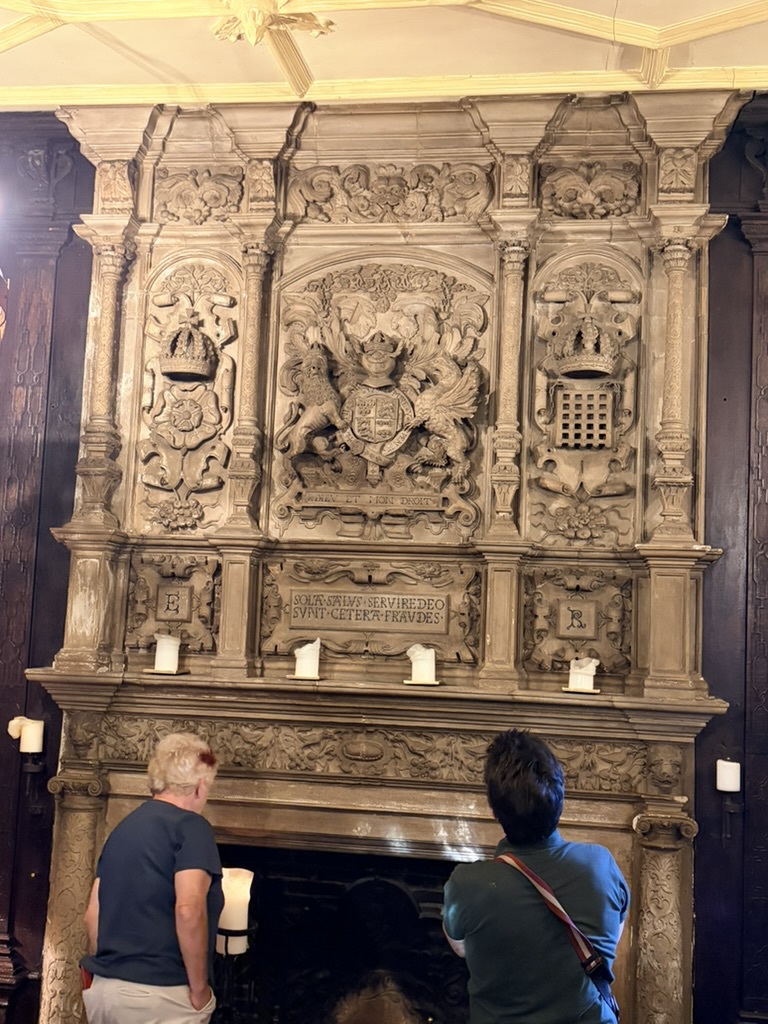
Carved into the stonework are the recurring symbols of the Tudor dynasty: the rose and portcullis together, the fleur-de-lis of France (a reminder that English kings still laid claim to the French throne at this date), the royal arms of England and France quartered, and the Garter with its motto, supported by the lion and the griffon. Our guide explained that these badges are properly called the Tudor “cognisance”, meaning a distinctive mark or emblem used to identify a person or house, much like a family crest.
One inscription on the fireplace reads, in Latin, roughly “safety alone lies in serving God, all else is deceit” (Sola salus servire Deo, sunt cetera fraudes). Another, harder to make out, has been read as referring to “dew upon the grass in the kindness of kings.”
Our guide suggested this second inscription might be a quiet nod from Princess Elizabeth to her half brother Edward, who as king granted her the manor of Enfield for her lifetime, at a time when she badly needed both a home and a sense of security.
Whose house was it, really
This is where the story gets interesting, because these relics did not come from a single grand palace. There were two significant Tudor houses in the area.
Elsyng Palace stood in what are now the grounds of Forty Hall. Built up by Sir Thomas Lovell in the early 1500s, it passed to Henry VIII in 1539 in exchange for other lands, and became a true royal residence, on a scale close to Hampton Court. All three of Henry’s children, Edward, Mary and Elizabeth, spent time there, and it was at Elsyng in 1547 that Edward and Elizabeth were told of their father’s death. Elizabeth continued to visit as Queen, drawn especially by the hunting in Enfield Chase, right up until 1596. By then the palace was falling into serious disrepair, and it was eventually demolished in the 1650s. Its exact location was lost until archaeologists rediscovered it in the 1960s, and excavations there continue today.
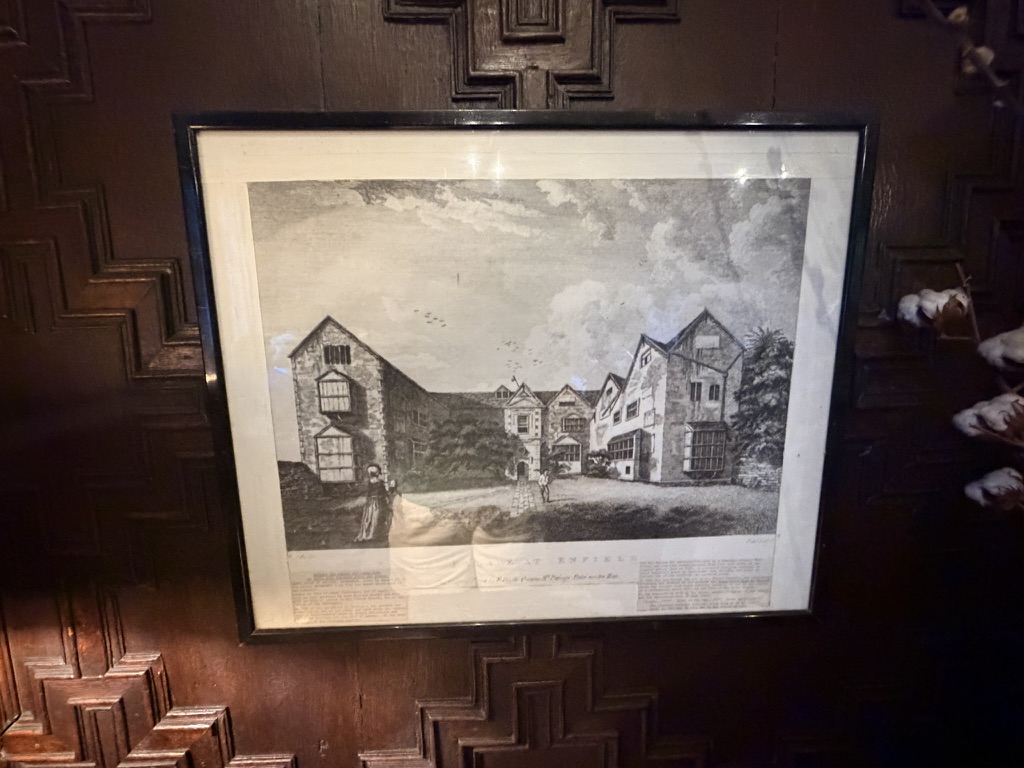
Enfield Manor House, in the heart of Enfield Town, is the building often loosely called “Enfield Palace”, a name that survives today in Palace Gardens and the Palace Exchange shopping centre, even though it was never actually a royal palace. It also came into the Crown’s hands in the 16th century, and in 1550 Edward VI granted it, together with Elsyng and other properties, to his sister Elizabeth for her lifetime. After Elizabeth’s death it passed through various owners and tenants, including a long spell as the parish post office, before finally being sold and demolished in the late 1920s, which is when the Legatt brothers stepped in.
Given how comparatively modest the Enfield Manor House was, our guide’s view was that the finest of these carved pieces, the overmantels especially, most likely began life at the grander Elsyng Palace and were moved to the manor house later, quite possibly by Elizabeth herself as Elsyng fell into decline, so that they would be kept somewhere still in good repair.
Forty Hall and the cedar tree
Forty Hall itself was built between 1629 and 1632 for Sir Nicholas Rainton, a wealthy haberdasher and future Lord Mayor of London. His nephew, also Nicholas, later bought up the by then abandoned Elsyng estate to extend the Forty Hall grounds, and allowed the old palace to fall further into ruin, eventually clearing the remains for a better view across his land.
In 1670 the old Enfield Manor House was leased to Dr Robert Uvedale, a keen botanist who ran a boys’ boarding school there and planted a cedar of Lebanon in the grounds, said to be among the first ever brought into this country. When Pearsons cleared the site in the late 1920s, that historic tree was felled too. A cross section of its trunk survives, and rather wonderfully, one slice of it is kept in the garden with a view of it from the room.
The stained glass, and a Spaniard in Tottenham
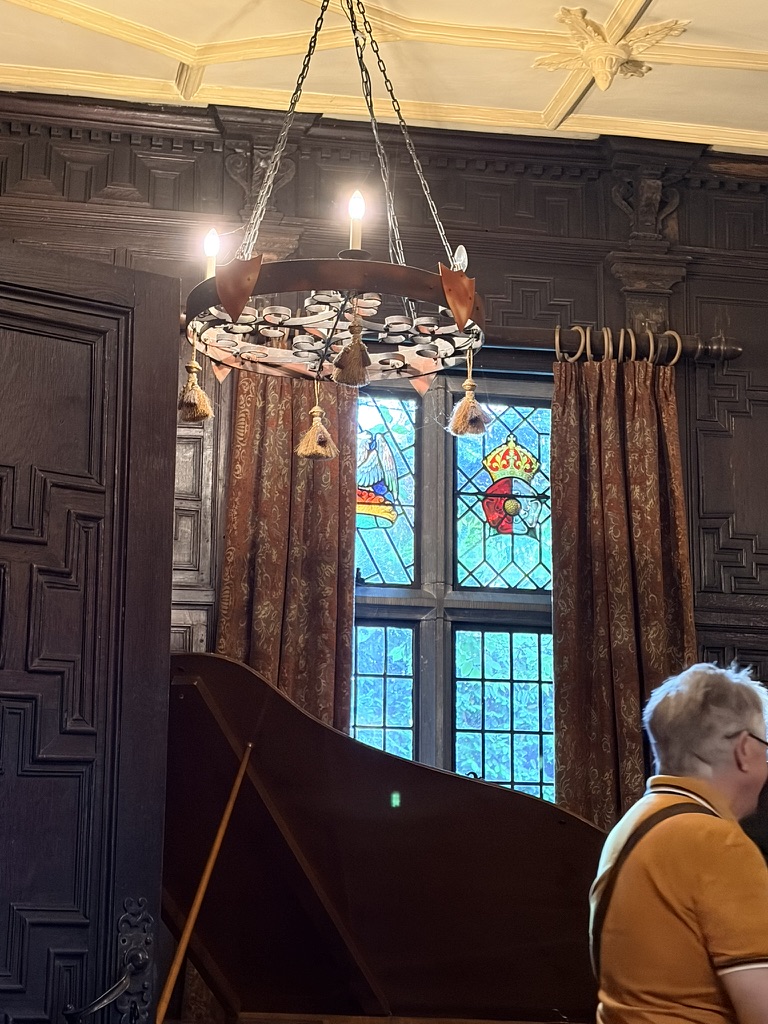
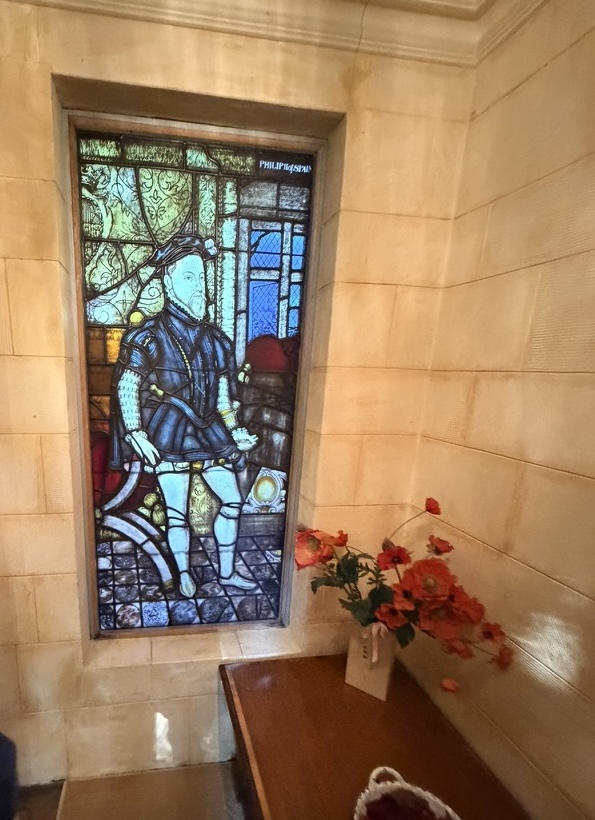
Squeezed into the corridor, we were shown a striking stained glass window depicting a young Philip of Spain, who briefly became King of England during his marriage to Mary I, a match that was never popular with his English subjects.
This led to a lovely aside about one of the more unexpected characters of the story: Balthasar Sanchez, a Spanish confectioner who had served King Philip II and travelled to England in Philip’s retinue when he married Mary. Sanchez settled in Tottenham and did rather well for himself. By the time he died in 1602, he was wealthy enough to leave money in his will to build eight almshouses for the poor of Tottenham, along with an endowment to look after the people who lived in them, a legacy that is still remembered locally today.
A room worth saving
Standing in the Tudor Room, surrounded by carved stone, dark panelling and centuries old glass, it is easy to forget you are in the middle of Enfield Town rather than a royal palace. That, in the end, is exactly the point. These pieces have no single, tidy provenance. They carry the fingerprints of Elsyng Palace, of the old Enfield Manor House, of Henry VIII’s building works and quite possibly of Elizabeth I’s own hand in preserving them. What is certain is that without the Legatt brothers’ decision to rescue them in 1928, none of it would have survived to be seen at all.
Our thanks to our hosts for so generously opening up their home, and to our guide for bringing all of this history to life.