 Can ChatGPT Find Your Business? What “AI Visibility” Actually Means
A client rang me last week, slightly rattled. She had asked ChatGPT to recommend a supplier in her field and her business had not come up. Someone else’s had. She wanted to know what she had done wrong.
She had not done anything wrong. But the question is a fair one, and it is being asked more often, which is why a certain kind of advertisement has started appearing in everyone’s feed. You will know the type. Your website was built to impress Google. Google is over. AI reads your site by completely different rules. There are six secret signals and your site is only sending one. Click here for a free scan.
I want to be straightforward with you about what is real here, what is sales pressure, and what you can actually do about it. Some of it matters. Most of the panic does not.
What is genuinely happening
People really are using ChatGPT, Claude, Perplexity, and Google’s AI summaries to find suppliers, compare options, and shortlist businesses. That is not marketing spin. It is a real shift in how some buyers behave, particularly for research-heavy purchases where someone wants a starting point rather than ten blue links.
So it is reasonable to ask whether those tools can see you.
What is being oversold
Here is the part the advertisements leave out. Nobody outside OpenAI and Anthropic knows how these systems decide which businesses to mention. There is no published ranking algorithm. There is no checklist of six signals. When you see a specific number like that, someone has invented it, because invented specificity sells better than honest uncertainty.
There is also a problem with the free scans. Asking an AI tool eight questions across two engines gives you a sample of sixteen answers, and these systems produce different answers on different runs. That is a snapshot, not a measurement. And the scan is not neutral. It exists to find gaps, because gaps are what the paid fix is for.
None of that means the underlying concern is fake. It means the diagnosis is being dressed up as science when it is closer to a vibe check.
What actually influences whether AI mentions you
When these tools answer a question about local suppliers, they are mostly doing one of two things. Either they are drawing on what was in their training data, which you cannot influence directly and which is often out of date, or they are running a web search and reading what comes back.
That second one you can absolutely influence. And it turns out the things that help are not exotic. They are the same fundamentals that have always made a website work, just applied with a bit more care about how a machine reads a page rather than how a person skims one.
Six things to check, in order
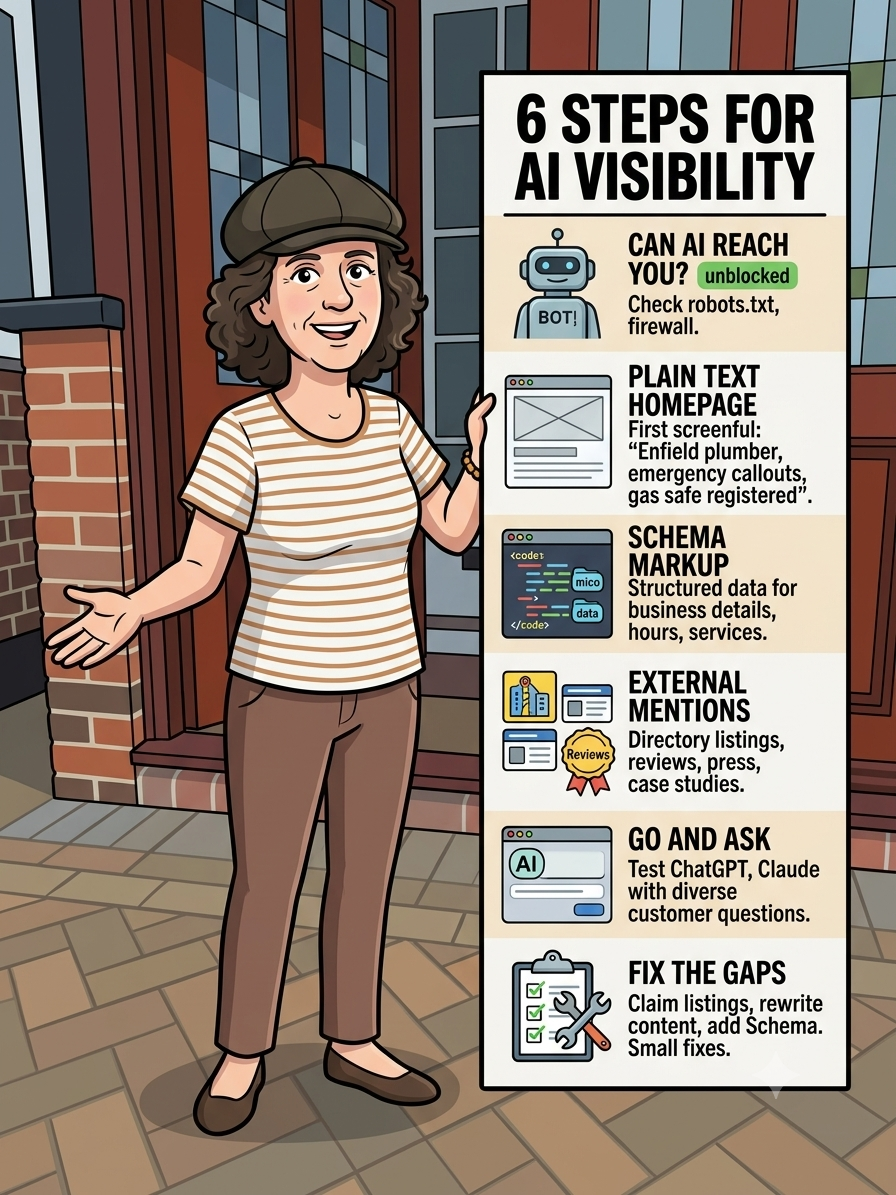
Ignore the six signals in the advert. Here are six things you can actually check.
1. Can AI tools reach your site at all?
Some hosting setups and security plugins block AI crawlers by default. Cloudflare in particular has been rolling out bot blocking that catches them. If GPTBot and ClaudeBot cannot fetch your pages, nothing else on this list matters. Check your robots.txt file and your firewall settings.
2. Does your homepage say plainly what you do and where?
Not in a slider. Not in an image. Not in a video header. In actual text, in the first screenful, in the sort of language a customer would use. “Enfield plumber, emergency callouts, gas safe registered” beats “delivering excellence since 2004.” Machines cannot read your logo.
3. Do you have structured data?
Schema markup is a small block of code that tells software what kind of business you are, where you are, what your opening hours are, and what services you offer. It has been good practice for years and most WordPress sites either lack it or have it filled in badly. This is usually a half hour job.
4. Does anyone else mention you?
An AI answering a question will lean on sources it can find. Reviews, directory listings, trade body memberships, local press, a supplier’s case study page. If your website is the only place on the internet your business name appears, you are invisible to anything that checks a second source. This is the single most underrated item on the list.
5. Go and ask.
Open ChatGPT and Claude. Type the question a real customer would type, in the words they would use, and see what comes back. Do it three or four times, because you will get different answers. This is the sixty second check the advertisements are charging for. It is free and you can do it yourself right now.
6. Fix the gaps.
They are usually small. A crawler unblocked, some schema added, a homepage rewritten in plain words, three directory listings claimed. This is rarely a rebuild, and anyone telling you it is should be asked why.
What I would say to my own clients
If your site is well built, properly structured, honest about what you do, and mentioned in a few other places on the internet, you are already doing most of what matters. The advertisements are selling urgency about a problem that, for a lot of well made sites, largely resolves itself.
If your site is a decade old, built around images, and has never had schema added, then yes, there is work to do. But that was true before anyone mentioned AI, and it was worth doing then.
The thing to resist is the idea that a whole new discipline has appeared overnight and you are already behind. Good structure, clear writing, genuine third party mentions. It is the same job it always was. The audience has just widened slightly.
If you would like me to run through the six checks above on your site, get in touch. It genuinely does not take long, and I will tell you honestly if the answer is that you are fine.